Agentic Automation for Business Processes in 2026: What Works, What Fails, and How to Build It Safely
Agentic Automation for Business Processes in 2026: What Works, What Fails, and How to Build It Safely
“AI agents will run your workflows” is everywhere right now. And there is truth in it: enterprise platforms are actively shipping agent-like capabilities, and big vendors are betting hard on this direction. (The Wall Street Journal)
But there is also a reality check: a large chunk of agentic AI work is getting stuck in pilots or getting canceled because teams underestimate the boring parts, like governance, observability, and integration reliability. (IT Pro)
This article is a practical guide for operations teams, product owners, and technical leaders who want agentic automation that actually survives contact with production.
If you want to talk through a specific workflow (ERP, BI, approvals, back office ops) and get a realistic plan based on your requirements and budget, you can reach CODO here:
https://codo.ltd/contact/
SEO meta (copy/paste)
Meta title: Agentic Automation for Business Processes in 2026: Practical Guide
Meta description: What agentic automation really means, where AI agents work best, why projects fail in production, and the guardrails needed for ERP, BI, and process management workflows.
What is agentic automation (in plain language)
Agentic automation is when an AI system does more than answer questions. It can:
- plan steps toward a goal
- call tools (APIs, databases, internal systems)
- take actions across multiple systems
- handle exceptions (or route them to a human)
- keep going until the job is done
In business terms, it is “workflow automation that can think through steps,” not just “a chatbot that suggests what to do.”
A key point: most real deployments are not fully autonomous. They use human review for critical decisions, especially anything with money, compliance, or customer impact. (IT Pro)
Why agentic automation is trending in 2026
Two reasons:
- Vendors are embedding agents into business software (IT ops, customer service, internal workflows). The ServiceNow and OpenAI partnership is one example of this broader push. (The Wall Street Journal)
- Companies want ROI from automation, and “agents” promise to automate work that is too variable for traditional rules and scripts.
At the same time, analysts are warning that a lot of projects will not make it past hype if teams cannot prove value and manage risk. (Gartner)
Where agentic automation actually works well (high ROI use cases)
These are the use cases we see succeed because the scope is clear and the outcome is measurable:
1) Process triage and routing
Example: support tickets, purchase requests, invoice exceptions.
- agent reads context
- classifies and routes
- asks for missing info
- escalates when needed
2) Data hygiene and master data cleanup
Example: CRM and ERP data quality tasks.
Agents can propose merges, flag inconsistencies, and open human review tasks.
3) Back office “glue work” across tools
Example: order issues that require checking ERP, shipping provider, and customer history.
Agents can gather evidence, propose resolution steps, and execute safe actions.
4) BI and reporting assistants with guardrails
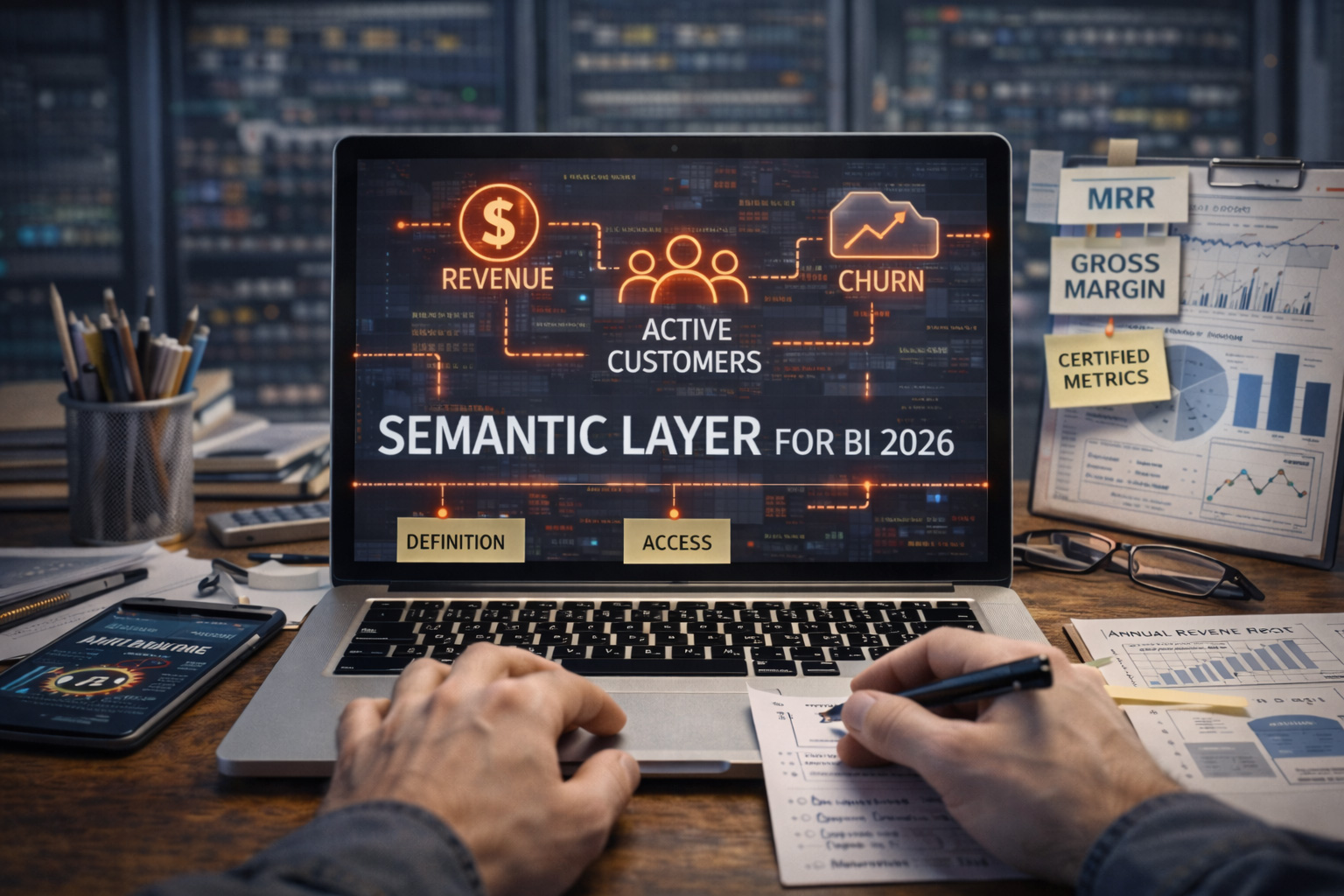
Agents can answer questions, but only if the metric definitions are consistent (semantic layer, governed definitions) and the data access is controlled.
A lot of enterprise leaders say the expected ROI is strongest in monitoring, cybersecurity, and data processing, which matches what is easiest to measure and control early. (IT Pro)
Why agentic automation fails in production (the common patterns)
This is the part most blog posts skip.
1) “Agent washing” and unrealistic autonomy
Many products labeled “agentic” are just chat + a few actions. Gartner and others have pointed out that hype causes teams to start the wrong projects. (Reuters)
2) No clear process ownership
If nobody owns the workflow end to end, you get endless debates like:
- who approves exceptions?
- what is the source of truth?
- what is a valid state transition?
Agents do not fix messy processes. They amplify them.
3) Weak integrations and no reliability layer
In real workflows, APIs fail, tokens expire, and data is missing.
Without retries, idempotency, logging, and dead letter handling, agents create chaos at scale.
4) Security, compliance, and audit gaps
A major reason projects get stuck is governance: permissioning, policy controls, and traceability. (IT Pro)
5) No observability
If you cannot answer “what did the agent do and why?”, you cannot run it in production.
Lack of visibility is repeatedly cited as a blocker to scaling agentic systems. (IT Pro)
The guardrails that make agentic automation production-ready
If you only take one thing from this article, take this: treat agents like junior operators with superpowers. They need boundaries.
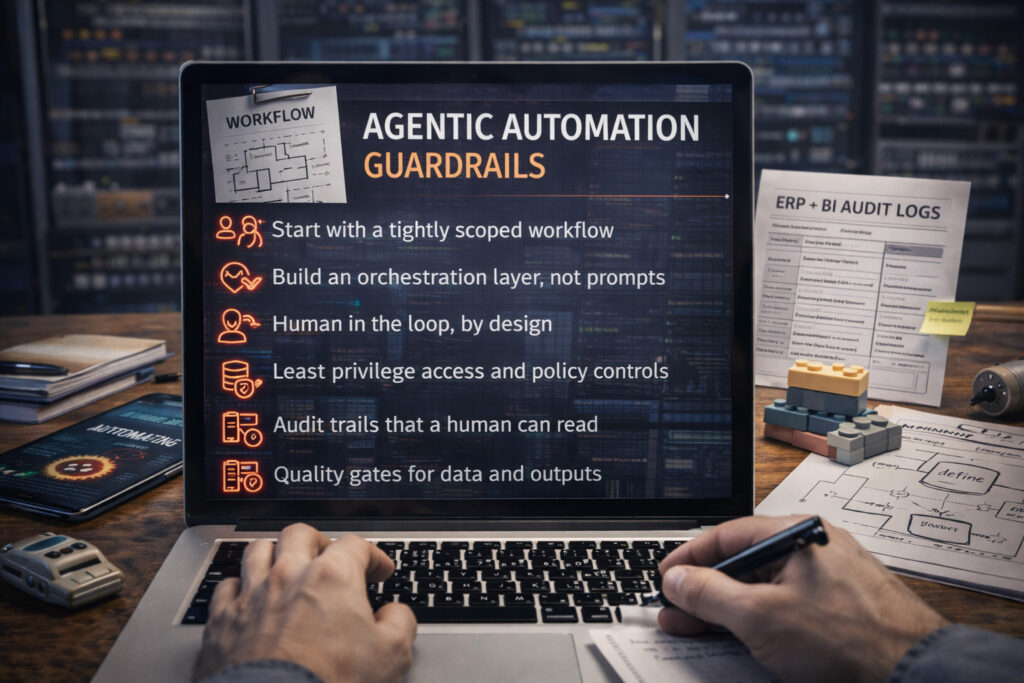
Guardrail 1: Start with a tightly scoped workflow
Pick one process with:
- clear start and end
- a measurable KPI (time saved, fewer errors, faster resolution)
- low blast radius (safe to rollback)
Bad first project: “automate operations”
Good first project: “triage invoice exceptions and open the right ticket with context”
Guardrail 2: Build an orchestration layer, not a pile of prompts
Your system needs a backbone that can:
- track state
- enforce steps and approvals
- record actions
- handle retries and failures
This is why “orchestration” keeps coming up in 2026 agentic automation guidance. (uipath.com)
Guardrail 3: Human in the loop, by design
Define which actions require approval:
- refunds, credits, payments
- vendor onboarding
- inventory adjustments
- role and permission changes
- anything regulated
Agents can prepare, propose, and execute only after approval.
Guardrail 4: Least privilege access and strong policy controls
Agents should not have broad admin tokens.
Use role-based access and per-tool permissions so the agent can only do what the process requires.
Guardrail 5: Audit trails that a human can read
You need logs like:
- what inputs were used
- what tools were called
- what changes were made
- what decisions were taken
- what confidence and rules were applied
This is essential for compliance and for debugging.
Guardrail 6: Quality gates for data and outputs
For BI and ERP processes, bad data creates confident wrong automation.
Add validation checks and fallback behavior.
A practical rollout plan (the one that avoids pilot purgatory)
This is a proven way to move from demo to production without burning months.
Phase 1: Process discovery (1 to 2 workflows)
- map the current flow
- define states, exceptions, approvals
- define success metrics
- define what tools the agent can call
Phase 2: Prototype with constraints
- implement the orchestration backbone
- add human approvals
- integrate one or two systems only
- log everything
Phase 3: Production hardening
- reliability patterns (retries, idempotency, monitoring)
- security review and permissions tightening
- testing against edge cases
- dashboards and alerts
Phase 4: Scale to adjacent processes
Once the pattern is stable, expand.
If you want to run this as a structured engineering effort (custom build or open source, depending on budget and requirements), CODO can help you design and build the orchestration and integration layers:
https://codo.ltd/contact/
FAQ
Do we need AI agents, or is normal automation enough?
If your process is stable and rule-based, traditional workflow automation is often better and cheaper.
Agents shine when variability is high (unstructured inputs, many systems, lots of exception handling).
Are agents safe for ERP workflows?
Yes, with constraints: approvals, limited permissions, audit trails, and strong integration reliability. Without guardrails, ERP is exactly where agent mistakes get expensive.
What is the biggest predictor of success?
Clear scope plus observability. Teams that can measure impact and trace behavior are the ones that get past pilot. (IT Pro)
A calm next step
If you are considering agentic automation for ERP, BI, or process management, start small, build the guardrails first, and treat reliability and auditability as non-negotiable.
If you want a second opinion on which workflows are worth automating and what architecture fits your budget (tailor-made or open source), contact CODO here:
https://codo.ltd/contact/